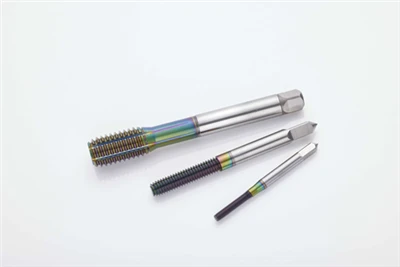
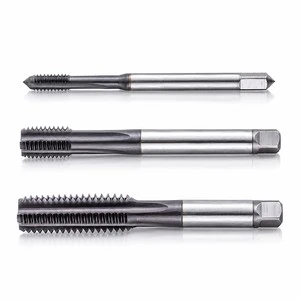
SW has restocked large-diameter HSS machine taps in its European warehouse: 2-3/4-8UN-2B straight-flute taps with TiN coating, and M24×3 spiral-flute taps with TiCN coating. The pair covers the two ways this work usually arrives - an inch-series thread on a valve body, flange or manifold, and a metric coarse thread on a heavy weldment. Both are aimed at shops cutting internal threads above 50 mm, where a 69.85 mm tap is no longer a scaled-up M24 but a different machining problem.
The 2-3/4-8UN is a Unified inch thread to ASME B1.1: 2-3/4 inch nominal diameter, 8 threads per inch, class 2B internal fit. In metric terms it is a 69.85 mm hole with a 3.175 mm pitch. The M24×3 is the metric coarse series to ISO 965-1, normally held to 6H.
|
|
2-3/4-8UN-2B |
M24x3 (6H) |
|
ASME B1.1, Unified, class 2B |
ISO 965-1, class 6H |
|
|
69.85 mm (2.750 in) |
24.00 mm |
|
|
3.175 mm (8 TPI) |
3.000 mm |
|
|
67.788 mm |
22.051 mm |
|
|
66.413 mm |
20.752 mm |
|
|
66.68 mm (2-5/8 in) |
21.00 mm |
|
|
Straight flute, 4 flutes |
||
Why a 69.85 mm tap is not a bigger M24
Three things scale faster than the diameter, and all three decide whether the job runs or breaks a tap inside a finished part.
Cutting speed is set by the material, not the size, so spindle speed is inversely proportional to diameter: n=1000 · vc / (π · D). At 6 m/min on mild steel, a 69.85 mm tap turns at roughly 27 rpm. An M24 at 12 m/min runs near 160 rpm. Most of the trouble shops report with big taps starts here: the machine has the power but not the low-end torque and control stability, so the tap chatters on entry and the first two threads come out oversize.
Thread area grows roughly with the square of the diameter while the lever arm grows linearly, so required torque is far more than the diameter ratio suggests. A 69.85 mm tap in structural steel will ask for a multiple of what an M24 needs - the practical answer is a radial drilling machine, a boring mill, or a CNC with rigid tapping and a genuinely low gear, plus a fixture that will not let the workpiece creep.
A straight-flute tap has to push the chip ahead of it. In a blind hole that is a dead end: chips pack, torque spikes, and the tap either stalls or strips. For through holes in valve bodies and flanges the straight-flute form is the right choice; for anything blind, either use a spiral-flute tap or switch process.
Tap or thread mill above 50 mm?
On a CNC, thread milling is usually the better answer for threads this size - but not always. The honest split:
when the part is expensive, the hole is near a shoulder, or the thread must be cut in hardened or difficult material. One carbide thread mill covers a range of diameters, cuts at 100–200 m/min instead of 6, and if it breaks you can usually recover the hole.
when the machine cannot interpolate a helix reliably, when the hole is deep and slender, when the volume is low and the setup cost of a thread-mill path is not worth it, or when the thread is a standard callout on a drawing that the customer expects to see tapped.
when the pilot hole is out of position. Check drill runout before the threading operation, not after.
Coating: why TiN on the big tap and TiCN on the M24
TiN is the general-purpose choice - around 2,300 HV, stable to roughly 600 ℃, good on carbon and low-alloy steel, and the gold colour makes wear on the flutes easy to read during setup. TiCN is harder, around 3,000 HV, with better abrasion resistance, which matters on smaller taps running at higher surface speed and higher chip load per flute. Neither is a substitute for the right substrate: for large taps the heat-treat batch and the core toughness decide whether the tool survives the first cut.
On a 69.85 mm thread, a scrapped part costs far more than the tool, so the paperwork is part of the product:
Material certificate to EN 10204 3.1 with the heat number, matched to the marking on the shank
For class 2B work: the go/no-go thread plug gauge callout, so the inspection matches ASME B1.1 rather than a shop-made gauge.
66.68 mm, which is 2-5/8 inch. That is nominal diameter minus one pitch (69.85 − 3.175 mm) and gives a thread height close to 75%. For a specific class or a shallow engagement, work to the drawing rather than the rule of thumb.
Not safely. The combination of low rpm and high torque means the workpiece, not the tap, becomes the weak link. Use a machine with a low-speed high-torque range and clamp the part; hand-tapping a thread this size is a last resort and usually ends in a bell-mouthed entry.
No. Under ASME B1.1, class 2B is the standard clearance fit for general-purpose internal threads, and it is what most drawings mean when they say "2B" without further note. Class 3B is the tighter, closer-tolerance option and is normally reserved for specific assembly requirements.
Neither is ideal for austenitic stainless; both work better with a sharp edge, generous lubrication and reduced cutting speed. If stainless is the main material, ask for AlTiN or an uncoated polished tool and expect to run slower again.
Send the thread designation, material, hole depth and machine type, and we will come back with the tool, the drill size and the cutting data. Drawings and non-standard forms welcome.